Reflection 5: Professional Development Day
This week, I attended Student AI Literacy Lessons K-12 with Cari Wilson, run as a part of the provincial professional development sessions.

To begin the session, Cari reviewed a brief history of AI, which essentially began in the 1940s when the idea arose that computers may surpass human intelligence. Technology and AI in the decades that followed brought rapid growth and development of AI, resulting in increasing demand for adaptation and learning on behalf of businesses, schools, and individuals. The rate at which these changes are occurring is baffling… it only took ChatGPT 5 days to reach one million users! In order to guide us through this learning, Cari spent the next part of her session outlining primary areas of importance for teachers and students using AI, and our responsibilities that coincide with them, as follows.
- Privacy – do our students protect their personal information while engaging with GenAI?
- Ethics – are the AI platforms we use operating responsibly, ethically, and fairly?
- Equity – do all students and teachers have access to the highest paid version of AI?
- Hallucinations – are our students educated enough to differentiate and identify hallucinations while using AI?
- Bias – are our students aware of bias inherently present in AI, the internet, and other forms of published information? Are they learning about bias in general?
- Deep Fakes – how can we teach ourselves and our students to identify whether media (photo, video) are real or not?
- Environmental Impacts – what is our country doing to mitigate environmental impacts of data labs? Why should our students know about this?
The final part of the session was spent outlining several resources and guidelines for teachers to support them in educating their students to use AI as a tool, in a safe, ethical and wise manner. A series of lessons has been posted by Focused Education, which provides a breakdown of the topics above for primary, intermediate, and secondary levels.
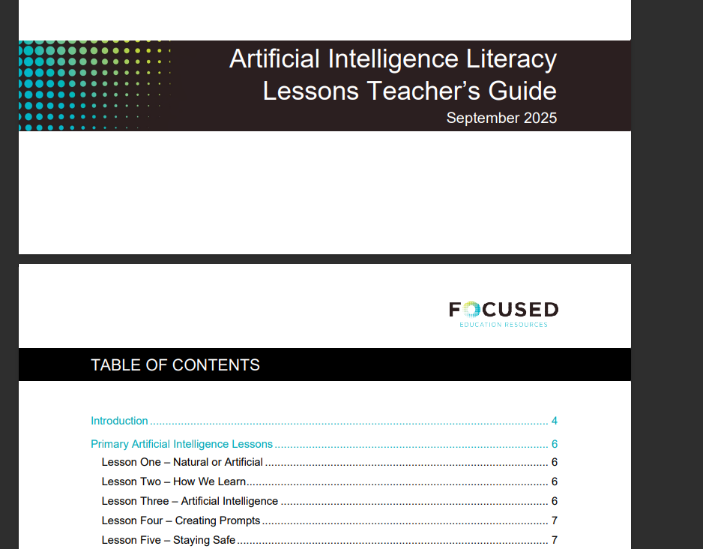
It is structured in a manner that requires teachers to provide one lesson a month about AI (with the exception of December, March and June), and is scaffolded through to grade 12. This way, students are learning a little more about AI every year, in a consistent, structured manner. This resource provides lesson outlines and pre-existing materials that teachers can deliver through their classrooms. The Teacher’s Guide is exceptionally useful and definitely something I will be saving to implement in my future classroom. Something I would add to this AI lesson model at a secondary level specifically, is the need to review research methods. Students learning how to write scientific or APA-style papers should also understand how to use (or not use) AI how to support their research, and be provided with other, non-AI platforms through which they can find peer-reviewed articles and research. This will support students as they cross the bridge to university, and encourage them to use ethical, established research platforms for their work, rather than relying solely on AI.
Overall, I found this session very useful and will be carrying several aspects of learning forward into my future classrooms as I embark on my own career in the field of education.
Images were generated by UnSplash and from Focused Education.